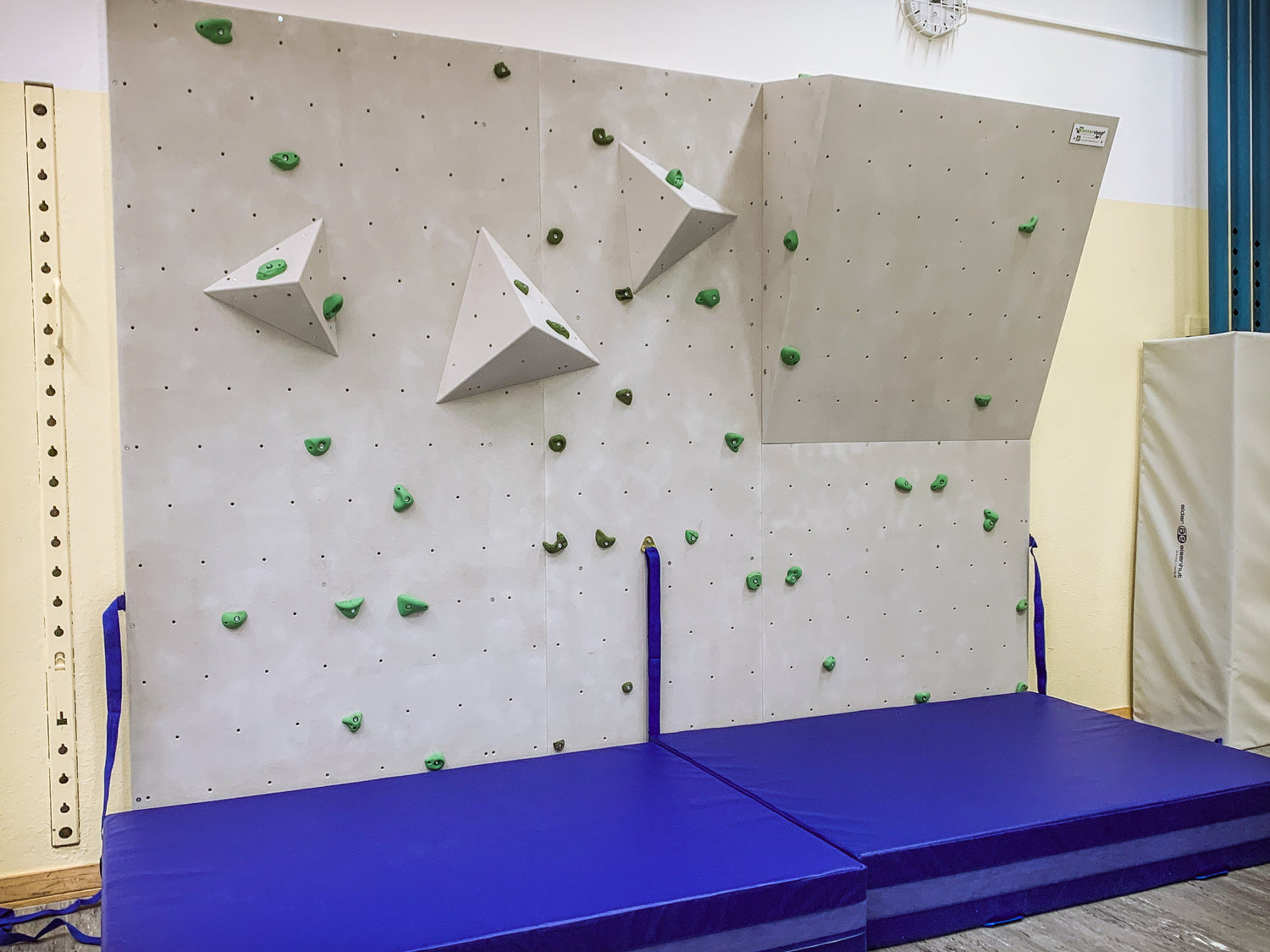
Our bouldering and climbing walls are constructed according to EN/SN 12572-1/2. The
panels we use are certified, and the quality certificates are available from us. The panels are maintenance-free and exhibit good resistance to many weak acids and acidic salt solutions. Alkaline solutions soften the surface. Direct contact with oxidizing agents such as chlorine, hypochlorites, and nitrates should be avoided. Alcohol and some other organic liquids have a water-like effect, meaning they cause swelling and slightly reduce strength. Petroleum has no effect other than discoloration. Phenolic resin coatings significantly increase the chemical resistance of plywood.
Our climbing holds are designed and manufactured with great care and should be treated with care. They are based on the Swiss standard EN 12572-3. Our climbing holds are made from a two-component polyurethane casting system (2K PU casting resin). The properties of the 2-component PU casting resin of our climbing holds are as follows according to DIN 53505, 53455, 53452, 51230, 53454: Hardness Shore D 82, tensile strength 163 kg/cm2, flexural strength 295 kg/cm2, compressive strength 917 kg/cm2.

Materials used, care and maintenance
Suggestions
If you follow the suggestions listed below, you will enjoy your climbing holds for a long time to come:
- The secure fit of the holds and footholds should be checked regularly, especially after seasonal changes, significant fluctuations in humidity, and large temperature differences. The take-off area should be kept clean.
- Regularly visually inspect the climbing holds and the landing area for damage or changes.
- Climbing holds and fasteners with damage must be replaced immediately with manufacturer's replacement parts. We use high-quality M10 threaded insert nuts with four prongs, weighing approximately 8 grams each, with a DIN EN ISO 4762-M10 socket head cap screw or a DIN EN ISO 10642-M10 countersunk screw, available in galvanized steel or stainless steel. Wall fixings in concrete or other materials must be calculated by a structural engineer. Please always consult with us before any maintenance work involving fixing replacements, or contact us for a maintenance service.
The climbing wall or bouldering wall should also be inspected annually by a qualified expert.
Cleaning : Our climbing holds have an extremely abrasion-resistant surface. Nevertheless, the holds can become dirty. To maintain optimal grip, the climbing holds should be cleaned regularly. Never use acids or alkalis for cleaning! This can destroy the resin structure and lead to premature breakage of the hold. We recommend warm water and a brush or a pressure washer for cleaning.
Visual inspection : Every time holds are screwed on or off, they should be carefully checked for damage to avoid reattaching a damaged hold!
Repair : As a general rule, a damaged hold must not be repaired! Risk of injury! Holds that have fallen and hit the ground or other hard surfaces must be disposed of immediately, as it cannot be ruled out that they have developed hairline cracks from the impact. This can lead to breakage later!
Disposal : The holds must be disposed of properly in accordance with standard EN 12572!
Instructions for use
- Climbing holds must have absolutely full contact with the surface. This means that at least the area covered by the hold must be perfectly flat. Uneven surfaces can lead to breakage during installation or under later load!
- When mounting the climbing holds, please note the following: Tighten the screws for mounting the holds to a torque specification or hand-tight + ¼ turn! – Spax screws should only be installed carefully using a torque-controlled power screwdriver!
- Very large or very positive holds should only be used in overhanging terrain to avoid injuries when jumping or sliding close to the wall!
- Only use the prescribed fastening systems, otherwise no liability can be accepted for the handles!
- These holds are only suitable for climbing with hands and feet! Please do not use the holds for dry tooling (climbing with an ice axe), as intermediate protection (hourglass sling), or for any other unintended uses!
We recommend ourselves for the maintenance of your bouldering or climbing wall. Please feel free to inquire about our rates.
As a general guideline, we refer you to the specialist brochure "Climbing Facilities," Copyright bfu 2015, www.bfu.ch